
What My Surgery Taught Me About Letting Go

A few weeks ago, I finally had surgery to repair a large abdominal hernia.
It wasn't something I particularly wanted to do. In fact, I'd managed to put it off for several years, which is quite impressive considering hernias are not generally known for responding to denial.
I kept hoping it wouldn't get any worse.
Of course, it did.
Eventually, I reached the point where I permanently looked several months pregnant and no amount of strategically chosen clothing was going to disguise the fact that something needed to be done.
So, after years of avoiding the inevitable, I had the surgery.
This was my tenth operation, so hospitals aren't exactly unfamiliar territory for me. Most of my previous surgeries had involved a night or two in hospital, followed by coming home and getting back into life reasonably quickly but this one was different.
Instead of keyhole surgery, I needed open abdominal surgery, followed by five nights in hospital and several weeks where I couldn't drive, lift anything heavy, vacuum, clean properly or do anything involving too much bending or twisting.
Basically, most of the things that keep a household running were suddenly off limits.
At first, I thought this sounded rather wonderful!
"My husband and sons can look after me for a change," I thought.
I may even have been slightly smug about it.
After all, I'm usually the organiser in our family. I'm the person who cooks most of the meals, does the cleaning, remembers what needs buying, notices when we're running out of something, keeps track of appointments and quietly holds all those little moving pieces of family life together.
You know, the things nobody particularly notices until somebody stops doing them.
I imagined myself reclining peacefully on the couch while my family brought me cups of tea and asked whether there was anything else they could possibly do for me.
This wasn't entirely how it unfolded.
Now don't get me wrong, my family looked after me.
Very well, actually.
The problem was me.
Because what I hadn't anticipated was just how difficult I would find it to stop being the person who made everything happen.
I would watch someone doing something and immediately feel the urge to offer a "helpful suggestion".
"That's not quite how I normally..."
Bite tongue.
"It might be easier if you..."
Bite tongue again.
The dishwasher was particularly challenging.
Apparently, there are many different ways to load a dishwasher. Who knew?
There is my way, which obviously makes perfect logical sense and then there are all the other ways people apparently manage to get perfectly clean dishes using methods I would never have considered.
It was quite confronting.
But something interesting happened when I stopped interfering.

The house didn't fall apart. Nobody starved. Clean clothes continued to mysteriously appear. The floors were vacuumed. The cat remained fed and life continued.
Things weren't always done when I would have done them or exactly how I would have done them, but after a while I started asking myself a surprisingly useful question.
Did it actually matter?
Most of the time, it didn't.
And once I stopped fighting the urge to control how everything was done, something shifted.
I started to enjoy it.
There was freedom in not being responsible for everything.
I could notice a basket of washing and, for once, not immediately start calculating when I was going to fold it.
Someone else could work out what was for dinner, the bane of my existence.
I didn't have to keep one part of my brain permanently occupied by that invisible running list of what needed doing next.
It was wonderful!
But something else was happening too.
As I stepped back, I watched the people around me step forward.
My boys did more.
My husband did more.
They worked things out without me.
They became more confident. They also began interacting with each other more.
My older son started picking his younger brother up from school. They spent more time together, talked more and began developing a relationship that was slightly more substantial than two people who happened to have bedrooms next to each other.
And I loved watching it happen.
It made me realise that sometimes, when we're very good at looking after everybody, we can accidentally become too good at it.
So good, in fact, that we don't always leave enough room for the people around us to step forward.
Nobody ever officially appointed me CEO of the Anderson household.

It just happened.
I suspect this is true for a lot of women.
Over the years, you become the person who knows when the toothpaste is running low, where the spare batteries are, when someone's appointment is, which child needs something for school tomorrow and why there is a mysterious container in the back of the fridge that nobody else appears capable of seeing.
Eventually, being the capable one becomes part of your identity.
And I can't deny there is something satisfying about being needed.
But underneath all of this was a slightly uncomfortable question I wasn't particularly keen to examine.
How much of the load had I genuinely been carrying because nobody else would do it, and how much had I continued carrying because I found it difficult to hand over or let go?
Probably a little of both but more of the second than I'd like to admit.
Because it's easy to complain that nobody helps while simultaneously hovering over them saying, "No, not like that."
It's easy to decide that doing something ourselves is quicker than explaining it.
And if we do that often enough, eventually everyone learns something very useful:
Mum will do it.
Which isn't necessarily the lesson we intended to teach.
And then I became bored out of my mind
For the first little while, surrendering responsibility felt glorious. I rested, people looked after me and I could sit on the couch while life carried on around me without feeling remotely responsible for any of it. After spending so many years encouraging other people to slow down, I thought perhaps I had finally mastered the art myself.
I hadn't.
Once the novelty wore off, I became bored out of my mind.
It was a strange kind of boredom because I wasn't well enough to return to normal life, but I was well enough to be very aware of all the things I couldn't do. I would find myself wandering aimlessly around the house looking for something, anything, that might occupy me for a while. I couldn't drive, clean, lift anything remotely heavy or do much that involved bending or twisting. Even the things I was allowed to do came with a fairly short expiry time because my energy would suddenly disappear and send me straight back to the couch.
There are only so many shows you can watch before you start eyeing off the pantry and wondering whether reorganising it with one hand could technically be classified as lifting.
I discovered that having absolutely nothing you have to do sounds much more appealing when you're incredibly busy and fantasising about it but when somebody actually removes most of your usual options and says, Now you must rest, it can feel surprisingly uncomfortable.
I think that was when the second part of my lesson began.
I'd learnt to let other people take care of things. Now I had to work out how to live at a different pace myself.
Without my usual routine, the days initially felt strangely shapeless. I'm accustomed to life having natural markers: work, appointments, driving somewhere, making dinner, getting something finished and moving on to whatever comes next. Suddenly most of those things had disappeared, leaving these enormous stretches of time that seemed to move at approximately half their normal speed.
Eventually, rather than spending my days waiting to be well enough to return to my old routine, I began creating a new one that fitted the life I could actually live at that moment.
It wasn't particularly ambitious. There would be some time sitting outside in the morning sunshine, a few hours on my laptop while stretched out on the couch, a little gentle movement within the limits my doctor had given me and, after lunch, the afternoon nap.
The nap took some getting used to.
I've always regarded sleeping in the middle of the day as something of a guilty pleasure. There is something about climbing into bed at one o'clock in the afternoon that makes you feel as though somewhere, an extremely responsible person is watching you with a clipboard in hand, shaking their head and making notes.
Could have been productive. Chose sleep instead. Dissappointing.
My body, however, was completely uninterested in my opinions about productivity.
By early afternoon I was exhausted. Not the pleasant I've had a busy day and could put my feet up kind of tired, but the sort where you feel like you have been unplugged from the wall and your energy dramatically drops.
So I slept.
At first, I still felt guilty about it. Then I began to understand that while it might have looked as though I was doing very little, my body was actually doing an extraordinary amount of work beneath the surface. Healing from major surgery takes energy, whether there is anything visible to show for it or not.
The nap gradually stopped feeling like an indulgence and simply became another marker in my new day.

Morning sunshine.
A little work.
Some gentle movement.
Lunch.
Sleep.
And strangely, once I stopped judging this quieter routine against my normal one, the days began to feel less empty. I wasn't simply passing time until I could get back to my "real" life. This was my life for a while, and once I accepted that there was something quite comforting about allowing it to be enough.
It also made me think about how complicated our relationship with rest can become, particularly when we're used to being productive and looking after other people.
I have always found it much easier to rest without guilt when I felt like I earned it.
Once the kitchen is clean, the emails are answered, the washing is folded, everyone else is okay and I've crossed enough things off my invisible list to justify sitting down, then I can finally exhale and think, Right. Now I can relax.
The problem, of course, is that the list never actually ends.
There is always something else to do.
You can reach the end of a perfectly productive day having accomplished an enormous amount and still look around to see seventeen other things you didn't get to.
If we only allow ourselves to rest once everything is finished, we may be waiting for a day that never actually comes.
Surgery temporarily took that choice away from me. I couldn't finish everything before I rested because I physically couldn't do everything. Some things had to wait. Some were done by other people. Some simply weren't done at all and I discovered some things weren’t as important as I once thought they were.
What I began to understand was that rest doesn't always have to be the reward we receive for finally being productive enough. Sometimes we need rest simply because we're human, because we're tired, because our bodies need it or because constantly being in motion isn't the only way to spend a worthwhile day or a worthwhile life.
I also learned that "good enough" really is good enough
There was one other lesson quietly making its way into all of this and it wasn't really about who cooked dinner, how the washing was hung out or whether the house was cleaned exactly the way I would have cleaned it. It was about the standards I had become accustomed to setting for myself and how rarely I stopped to question whether all of them were actually necessary.

Over the years, getting things done simply became the natural rhythm of life. There was always something that needed my attention and because I was capable of doing it, I usually did. Somewhere along the way, I became so accustomed to measuring my days by what I had accomplished that I rarely stopped to consider whether everything I was doing really needed to be done at all. Recovery gave me little choice but to find out.
The house could be a little messier without becoming a health hazard. Dinner could be something easy and nobody complained. An email could wait until tomorrow, the washing could remain happily in its basket and sometimes an entire day could pass without anything particularly impressive being achieved.
And it could still be a perfectly good day.
I've started to think differently about the idea of good enough because of that.
For a long time, those words sounded suspiciously like settling to me. "Good enough" seemed to suggest lowering the bar, putting in less effort or not caring enough to do something properly. I like doing things well and I don't think there's anything wrong with taking pride in the things that genuinely matter to us but what I've discovered is that not everything deserves the same amount of us.
Our time, attention and energy are finite and every bit of ourselves we pour into making one thing perfect is something we can't give to something else. There will always be things worthy of our very best effort but I'm increasingly convinced that the dishwasher isn't one of them.
Maybe good enough isn't about caring less at all. Maybe it's about becoming more discerning about what deserves our time and attention.
I'm not suggesting I've emerged from surgery as a completely transformed woman who has released all attachment to productivity and household standards. I still like a reasonably clean house, I still have opinions about dishwasher stacking and I have absolutely no intention of gazing serenely at a mountain of washing and whispering, "It will be done when the universe is ready."
That's not me.
But perhaps there is a rather large and comfortable space somewhere between trying to hold everything together and abandoning all standards entirely. A place where we can care deeply about the things that matter without exhausting ourselves over all the things that really don't.

I think I'd like to spend a little more time there.
What will I take back with me?
As I gradually return to normal life, I've found myself thinking less about all the things I'm looking forward to doing again and more about which things I actually want to take back.
Because I know how easily it could happen.
As soon as I'm physically able, I could quietly reclaim the cleaning, the organising, the remembering and all those invisible little jobs that I automatically did before, simply because I was there and I could. The familiar mental list could start running in the background again and, within a few weeks, life could look almost exactly as it did before.
I'm not sure I want it to.
One of the unexpected gifts of being forced to step back has been discovering what happens in the space we leave behind when we stop automatically filling it ourselves.
My family stepped into that space. My boys became more independent and, unexpectedly, spent more time together. My husband carried things I would normally have carried. Problems arose and were solved without me and quite a few of them were solved perfectly well.
There is something both humbling and liberating about discovering that you are not quite as indispensable as you may have imagined.
But while they were discovering what they could do without me constantly stepping in, I was discovering something about myself too.
I discovered that I could sit outside in the sunshine before everything was finished and enjoy the warmth on my face without immediately getting up to tackle the next job. I could sleep in the afternoon when my body was tired, leave something until tomorrow and allow another person to take responsibility for something without supervising the process from the couch.
Most importantly, I began to see that I could still be me without constantly proving my usefulness through how much I managed to get done.
I think that may be the lesson I most want to carry with me when all of this is over.
Somewhere along the way, being capable had become tangled up with being needed, and being needed had become tangled up with doing. The more I could carry, the more I carried, until carrying all those things simply became part of who I was.
Surgery temporarily untangled those things for me.
That's what letting go really is.
It isn't about caring less, giving up or lowering our standards. It's recognising that we don't have to carry everything simply because we've become very good at carrying it, and that putting something down doesn't make us less capable, less needed or less valuable.
Stepping back gives someone else the opportunity to step forward. Leaving something unfinished gives us the opportunity to rest and allowing something to be done differently reminds us that our way was never the only way. And good enough really is good enough.
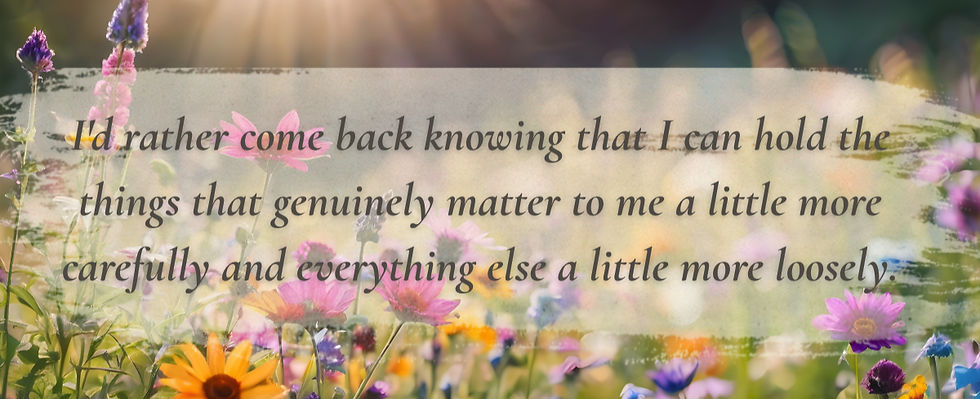
I don't want to come back determined to carry everything again.
If some of this felt familiar
You might enjoy my book, Stop Rushing Start Living. It's about many of these same things: slowing down, stepping out of constant doing and creating a life with a little more room to breathe.
And if you'd like more of these conversations, you can also join my email community. I share my latest articles, YoutTibe videos, practical psychology, gentle reminders to slow down and the occasional glimpse into what I'm learning in my own life along the way.
Because none of us need another list of things we're supposed to be doing perfectly. We just need a reminder that what we're already doing might be enough.
Written by Liz Anderson
Liz Anderson is a registered psychologist, author and creator of Slow Down with Liz. With more than 30 years of experience in psychology, she writes about slowing down, navigating the messy parts of life and creating more space for what really matters.


Comments