
Why Your Brain Notices the Bad Stuff First

I love being a psychologist.
After more than thirty years of sitting with people through some of the hardest moments of their lives, I genuinely feel privileged to do the work I do. My clients have taught me as much about courage, resilience and hope as any textbook or university degree ever could.
But psychologists are human too.
We have bad days.
Days when self-doubt quietly creeps in.
Days when that little voice in our heads, the one my friend affectionately calls the bitch in the attic, decides it's time to remind us of every mistake we've ever made, every plan that didn't quite work out and every reason why the future probably won't either.
Some days she's incredibly convincing.
On those days it can feel almost impossible to remember your strengths. Instead, your mind becomes a detective searching for evidence that things won't work out.
As psychologists, we have a number of names for the thinking patterns that can feed moments like these. Sometimes it's self-critical thinking. Sometimes it's catastrophising. Sometimes it's confirmation bias.
But underneath many of them sits something far more fundamental.
Our brains are naturally wired to notice what might go wrong.
Psychologists call this our negativity bias.
Negativity Bias: Annoying or Actually Quite Clever?

As much as it can drive us absolutely nuts, our negativity bias is actually rather clever.
Thousands of years ago, it was one of the reasons our ancestors survived.
The people who noticed the snake hiding in the long grass, the storm rolling over the horizon or the rather grumpy-looking saber-toothed tiger lurking behind the bushes were far more likely to live long enough to pass on their genes than the ones wandering through life admiring the wildflowers.
Don't get me wrong, I like admiring flowers as much as the next person.
But if Barry is busy saying, "Oh look, aren't those daisies lovely?" while Trevor is yelling, "Barry! Run!" ... history suggests Trevor probably had the better survival strategy.
The remarkable thing is that although we've invented smartphones, air fryers and cars that can park themselves, our brains haven't received nearly as many software updates.
They're still running much the same operating system they were hundreds of thousands of years ago.
The problem is that most of us aren't trying to avoid saber-toothed tigers anymore.
We're trying to juggle overflowing inboxes, ageing parents, teenagers, deadlines, finances and the endless mental load that seems to come with being an adult.
Yet our brains continue scanning for danger as though we're about to become something's lunch.
Only now the danger sounds a little different.
"I hope I don't burn out."
"I can't afford to fail."
"I don't want to let everyone down."
"What if I get sick?"
Before we know it, our attention becomes fixed on everything we're trying to avoid.
Our brains think they're protecting us but sometimes they're just exhausting us.
The interesting thing is that our brains don't distinguish particularly well between a life-threatening emergency and an unanswered email, an awkward conversation or a difficult meeting. They simply notice something that feels important or uncertain and sound the alarm. That's incredibly useful if you're standing in front of a charging tiger. It's rather less helpful when you're lying awake at two o'clock in the morning replaying a conversation from Tuesday.
The good news is that our brains aren't set in stone. While we may not be able to stop them noticing the negative, we can gently teach them to notice the good as well. Over time, that helps us develop a more balanced view of ourselves, our lives and the world around us.
This Isn't About Positive Thinking

Now, before you decide this is going to be another article telling you to "just think positive" and "look on the bright side of life," let me reassure you, that's not where we're heading.
If positive thinking alone solved life's problems, we'd all be millionaires with six-packs, perfectly behaved children, spotless houses and laundry that somehow magically folded itself.
Sadly, life doesn't seem to work like that.
Sometimes life is genuinely hard.
People worry about paying the rent, deciding whether they can afford to put petrol in the car, juggling caring responsibilities, navigating relationship difficulties or simply finding enough energy to make it through another exhausting week.
Those struggles are real, and no amount of positive thinking makes them disappear.
That's not what I'm talking about.
What I am talking about is where our attention settles.
If we spend all of our time focusing on what's missing, what's going wrong or what we're afraid might happen next, that gradually becomes all we can see. It's a little like walking through a beautiful garden while staring only at the weeds.
The weeds are real.
They deserve to be acknowledged.
But they aren't the entire garden.
Alongside the difficult things, there are often small moments that quietly help us keep going—a friend who always knows how to make us laugh, a warm cup of coffee, food in the pantry, running water from the tap, a dog who greets us at the door or the first rays of sunshine after a difficult week.
Shifting our attention doesn't erase our problems.
It simply reminds us that they aren't the whole story.
Ways to Redirect Your Attention
Before I share a few ideas that have helped me and many of my clients over the years, I think it's important to say one thing.
Redirecting your attention isn't about pretending difficult things don't exist.
If something is worrying you, acknowledge it.
Your feelings are valid.
Sometimes we simply need to give our worries somewhere to land rather than allowing them to follow us around all day like an overenthusiastic toddler asking, "Are we there yet? Are we there yet? Are we there yet?"
Whether that's writing them in a worry journal, scheduling some "worry time" later in the day or talking them through with someone you trust, giving those thoughts a place to go often stops them from bouncing endlessly around inside your head.
Once we've acknowledged the difficult stuff, that's when something interesting can happen.
I often think of our attention as an old-fashioned set of balance scales.
On one side sits everything our negativity bias has collected for us that day: the worries, the mistakes, the awkward conversation we wish we'd handled differently, the uncertainty about tomorrow and the endless list of things still waiting to be done.
On the other side are the quieter moments that our brains rarely bother to point out because they don't involve danger. A kind word from a friend. A warm cup of coffee enjoyed before the rest of the house wakes up. The dog curled up asleep at your feet. A project you're slowly bringing to life with your own hands. A sunset that makes you stop for just a moment and realise the world is still turning exactly as it should.
The interesting thing is that we don't need to remove all the weight from the difficult side of the scales. That isn't realistic, and it isn't the goal.
What we can do is begin placing a few more things on the other side.
Little by little, the balance starts to shift.
Not because life has suddenly become easier, but because we're allowing ourselves to see more of it.
Over the years, I've discovered a handful of simple practices that help me do exactly that. They're certainly not magic, and they don't make difficult days disappear. What they do is gently remind me that the voice in my head isn't always telling the whole story.
Gratitude Jar

One of my favourites is keeping a gratitude jar. Every time something good happens, no matter how small, I write it on a little piece of paper and drop it into the jar. It might be a lovely compliment from a client, a beautiful sunrise, finishing a blog I'm proud of, sharing a laugh with my family or simply having one of those rare days where everything feels just that little bit lighter.
Then, when the bitch in the attic decides she's
running for Prime Minister and insists on broadcasting her opinions all day long, I can pull out a handful of those little notes and remind myself that difficult moments are only one chapter of the story, not the entire book.
Positive Journal
I've also kept what I call a positive journal over the years. It's not filled with motivational quotes or declarations that every day is amazing because, quite frankly, some days aren't. Instead, it's somewhere to collect the things my brain is naturally inclined to forget. A kind email. A problem I managed to solve. A moment I felt proud of myself. Something that made me laugh. A small achievement that would probably have disappeared from memory by the following week if I hadn't written it down.
Our brains are remarkably efficient at storing criticism. Sometimes they need a little help remembering encouragement as well.
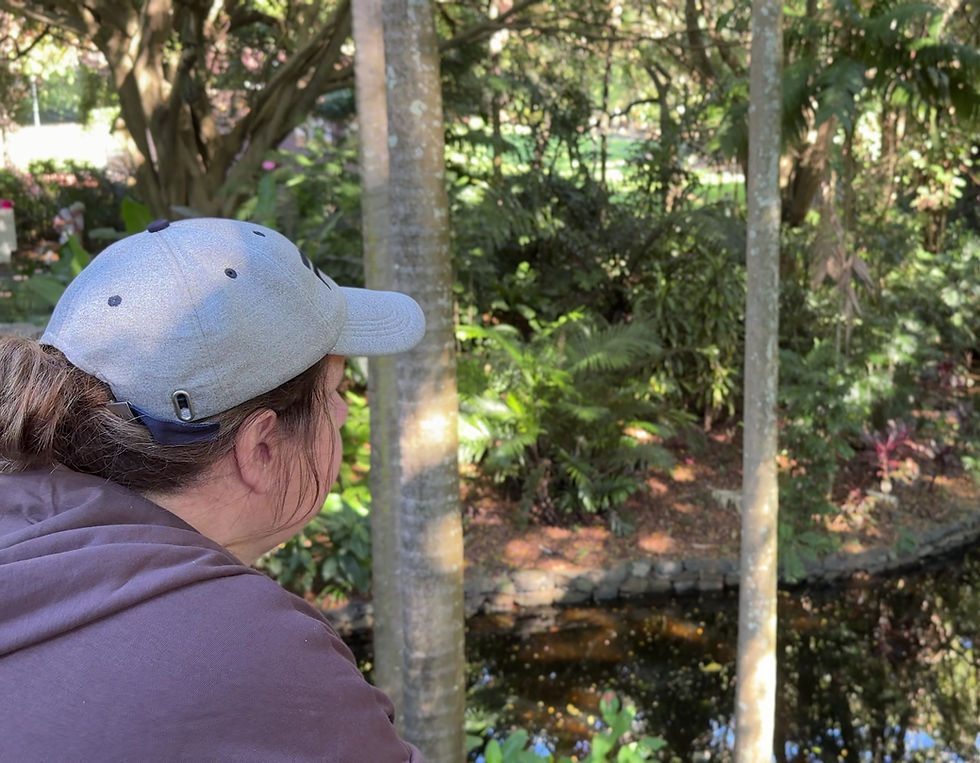
Spend Time in Nature
Another place I regularly find myself returning to is nature. There is something wonderfully grounding about stepping outside and realising that the trees aren't worried about my to-do list. The birds haven't spent the morning replaying an awkward conversation from last Tuesday. They simply get on with being birds. Somehow, listening to the wind moving through the trees or feeling the warmth of the sun on my face reminds me that there is a much bigger world beyond whatever my mind has decided deserves centre stage today.
Create Something
And then, of course, there is creativity.
If you've read last week's blog, you'll already know I have a habit of collecting hobbies. Whether I'm building another tiny book nook, making something from polymer clay or disappearing into some completely new creative rabbit hole, I notice the same thing every time. My attention quietly shifts. For an hour or two I'm no longer living in tomorrow's worries. I'm simply making something with my hands.
Curiously, that's often enough.
Not because my problems have disappeared while I was busy making a tiny café for imaginary people, but because my mind has finally been given permission to rest.
Whenever I notice myself slipping back into that familiar cycle of worrying about everything that could go wrong, I try to pause and ask myself one very simple question.
Ask Yourself One Gentle Question

What do I want more of today?
Not next year.
Not when life finally settles down.
Just today.
Perhaps it's a little more peace. A little more laughter. A little more patience. A little more courage. A little more connection.
I don't always have the answer immediately.
But I've found that asking a better question often leads me towards a better direction.
Because perhaps that's what redirecting our attention is really about.
Not pretending the weeds don't exist.
Simply remembering to notice the flowers as well.
Want More Gentle Psychology and Practical Ways to Slow Down?
If you enjoyed this article, I'd love to welcome you into my Slow Down Community.
Each week I send a gentle email filled with practical psychology, thoughtful reflections, free printable resources and encouragement to help you slow down, stress less, reconnect with yourself and create a calmer, more meaningful life.
While you're here, why not join my free 7 Days to a Calmer You email challenge? Over seven days, you'll receive simple, practical strategies to help you feel calmer, more grounded, more present and more in control.

Written by Liz Anderson
Liz Anderson is a registered psychologist with more than 30 years' experience helping people manage stress, anxiety and life's challenges. She is the author of Stop Rushing, Start Living and the founder of Slow Down With Liz, where she shares practical psychology, gentle reflections and simple strategies to help busy people reconnect with themselves and create calmer, more meaningful lives.
When she's not writing or seeing clients, you'll often find her creating book nooks, making something with polymer clay, walking in nature or dreaming up her next creative project.


Comments