
5 Signs You Need Better Boundaries (And How to Start Setting Them Without Feeling Guilty)

Have you ever found yourself snapping at someone you love over something completely insignificant?
Maybe someone asked you yet another question when you'd finally sat down for five minutes to relax.
Maybe the dishwasher needed emptying and it was left up to you.....again.
Maybe somebody was breathing a little too loudly and, for reasons you couldn't fully explain, it felt like the final straw.
If so, you're not alone.
As a psychologist, one of the most common things I see in women struggling with stress, overwhelm, anxiety and burnout is a lack of healthy boundaries. Not because they're weak, selfish, or incapable, but because they're often caring, capable people who have spent years putting everyone else's needs ahead of their own.
I know because I've been there myself.
For a long time, I was a people pleaser. I was very good at helping everyone else while completely ignoring my own advice. I said yes when I wanted to say no. I took on too much responsibility. I convinced myself that being constantly busy and available was simply part of being a good person.
The problem was that eventually it caught up with me.
Looking back, there were plenty of warning signs. I felt overwhelmed more often than I wanted to admit. My patience was shorter than it used to be. I felt stretched too thin and no matter how much I got done, there always seemed to be more waiting around the corner.
Then somewhere around my 50th birthday, I had one of those moments of clarity that often arrives when you've finally had enough.
I remember thinking, "I'm getting too old for this shit."
Life felt too precious to spend constantly rushing, constantly giving and constantly putting myself last.
Something needed to change.
What I eventually realised was that I didn't have a time management problem.
I had a boundary problem. That was a revelation!

The interesting thing about boundaries is that most of us don't realise we need them until we've been struggling for quite some time. Our mind and body usually start sending warning signals long before we consciously recognise what's happening.
Here are five common signs you may need better boundaries in your life.
1. You're More Irritable Than Usual
Suddenly, the little things that normally wouldn't bother you begin getting under your skin.
The child asking another question.
The email arriving at the wrong moment.
The partner who leaves their coffee cup on the bench.
The thing itself isn't usually the problem.
It's simply the straw landing on a back that's already carrying far too much.
Many people judge themselves when this happens. They assume they're becoming less patient or less kind. Or just plain grumpy.
But irritability can be a warning sign. It's your mind and body letting you know that something needs attention.
2. You Feel Resentful More Often
Resentment is another common sign that healthier boundaries may be needed.
Unlike anger, resentment rarely appears overnight.
It builds quietly over weeks, months, and sometimes years.
You start noticing thoughts creeping in:
"Why is this always up to me?"
"When do I get a break?"
You may not say those thoughts out loud, but they're there.
Resentment often develops when we've spent a long time taking care of everyone else's needs while repeatedly neglecting our own.

The truth is, resentment doesn't mean you're selfish or jealous.
More often, it means you've been giving too much of yourself for too long without enough replenishment.
Your cup isn't simply running low.
It's bone dry.
3. You Want to Hide From the World
One of the most misunderstood signs of overwhelm is withdrawal.
People often assume that if they're procrastinating, cancelling plans, avoiding tasks, or spending hours scrolling their phone, they must be lazy or unmotivated.
That's rarely the case. More often, I see a nervous system that is exhausted and trying to conserve energy.
When you've been running on empty for a long time, even things you normally enjoy can start feeling like too much effort.
Socialising feels exhausting.
Replying to messages feels exhausting.
Making decisions feels exhausting.

You may even find yourself fantasising about disappearing somewhere quiet where nobody needs anything from you.
No responsibilities.
No demands.
No one calling your name every five minutes.
Withdrawal isn't always a sign that you need to just try harder.
It's often a sign that you need more support, more rest and better boundaries around what you're carrying.
4. Your Brain Won't Switch Off
One of the most common complaints I hear from clients is:
"My brain just won't stop!"
Even when the day is over, the mind keeps going.
Replaying conversations.
Planning tomorrow.
Worrying about next week.
Questioning decisions.
Trying to solve problems that haven't even happened yet.
Over time, your brain can become stuck in permanent problem-solving mode and this can start to feel normal. In fact, many people become so accustomed to mental busyness that calm feels unfamiliar, even uncomfortable.
The problem is that our brains were never designed to stay switched on all the time.
At some point, they need rest.
They need space.
They need permission to stop.
5. You Feel Emotionally Exhausted

This is often the point where people tell me: "I've got nothing left."
They're not simply tired. They're exhausted.
Simple tasks feel harder than they should.
Replying to messages.
Cooking dinner.
Making decisions.
Showing up for one more responsibility.
This isn't weakness or poor coping skills.
It's depletion.
When you've been carrying stress, emotional load, responsibility and pressure for months or years, it uses an enormous amount of energy.
Eventually, the tank runs low.
When that happens, many of us start looking for ways to fill it back up.
Comfort food.
Sugar.
Scrolling.
Online shopping.
A few extra glasses of wine.
Anything that provides temporary relief.
The problem is that what we're often craving isn't more stimulation.
It's rest.
It's support.
It's space.
It's a chance to finally put some of the load down.
That's why burnout can feel so physical.
The mind and body are deeply connected.
When one is struggling, the other almost always feels it too.
What Boundaries Really Are
One of the biggest misconceptions about healthy boundaries is that they're confrontational.
People imagine awkward conversations, conflict, or disappointing someone they care about.
But boundaries are often much simpler than that.

At their core, boundaries are simply decisions that protect your time, energy, wellbeing and peace of mind.
You're already setting boundaries every day.
Choosing to go to bed earlier.
Limiting your screen time.
Deciding not to engage in a particular conversation.
Making time for exercise.
Saying yes to something important.
Saying no to something that doesn't align with your priorities.
These are all boundaries.
Some are shared with other people.
Others are private decisions you make for yourself.
How to Start Setting Boundaries Without Feeling Guilty
The first step is AWARENESS
Notice what drains your energy.
Notice what leaves you feeling resentful.
Notice what repeatedly overwhelms you.
One of the simplest things I do when I start feeling overwhelmed is get everything out of my head and onto paper.
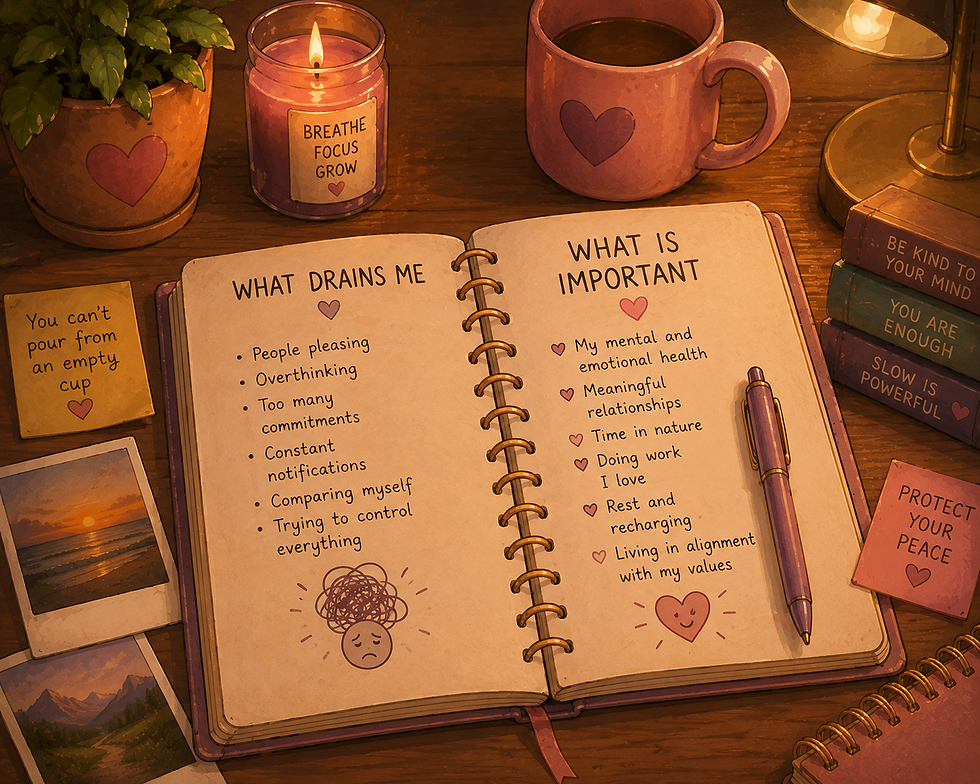
I ask myself:
Where do I feel stretched too thin?
What's taking more than it's giving?
What can wait?
What can be delegated?
What do I no longer want to carry?
Awareness creates clarity and clarity creates change.
DON'T GO OVERBOARD
One of the biggest mistakes people make with boundaries is thinking they need to change everything overnight.
You don't.
Start small.
In fact, some of the most powerful boundaries are the quiet little ones you set for yourself.
Maybe it's:
• I'm going to take one minute each day to stop, breathe, and reset.
• I'm not answering emails after 8pm.
• I'm going to stop saying yes automatically and give myself time to think first.
Build your confidence with the easier boundaries first.
Small changes are often what create the biggest shifts in how calm, grounded and balanced you feel.
PRACTICE, PRACTICE, PRACTICE.

Like anything in life, boundaries get easier with practice.
You slowly build your boundary muscles over time.
Every time you set a healthy boundary, your nervous system learns something important:
It's safe for me to protect my time.
It's safe for me to protect my energy.
It's safe for me to protect my wellbeing.
The world doesn't fall apart when you say no.
People might need some time to adjust.
And that's okay.
The people who genuinely care about you will usually learn to understand and respect your boundaries.
A Final Thought
If you've recognised yourself in some of these signs, don't panic.
You don't need to change everything overnight.
You don't need to become a different person.
Start by simply listening to what your mind and body have been trying to tell you.
Boundaries aren't about shutting people out.
They're about creating enough space in your life to reconnect with yourself again.
You are allowed to protect your peace.
You are allowed to rest.
And you are allowed to create a life that feels calmer, healthier and more sustainable for you too.
If you'd like some extra support moving from feeling overwhelmed and stretched too thin to feeling calmer, more grounded, and more connected to yourself again, I've created a free resource called 7 Days to a Calmer You.
For seven days you'll receive a simple daily email filled with practical strategies, nervous system support tools, mindfulness exercises, reflections, and encouragement.
There's nothing to attend live.
No pressure.
And you can work through it all in your own time and at your own pace.
Click here to start the challenge.
For a more in-depth discussion of this topic, watch my YouTube video here.

Written by Liz Anderson, Psychologist
Liz Anderson is a psychologist and author of Stop Rushing Start Living: A Psychologist's Guide to Slowing Down, Stressing Less and Calming the Mind. Drawing on over 25 years of experience, she shares practical, evidence-informed strategies to help busy women feel calmer, more present, and less overwhelmed by the demands of everyday life.
If you found this helpful, drop by my website for more useful information on bringing more calm, clarity and joy into your life https://www.slowdownwithliz.com.


Comments